
Sun Studio
Discover Sun Studio: A New Experience in Scientific Computing
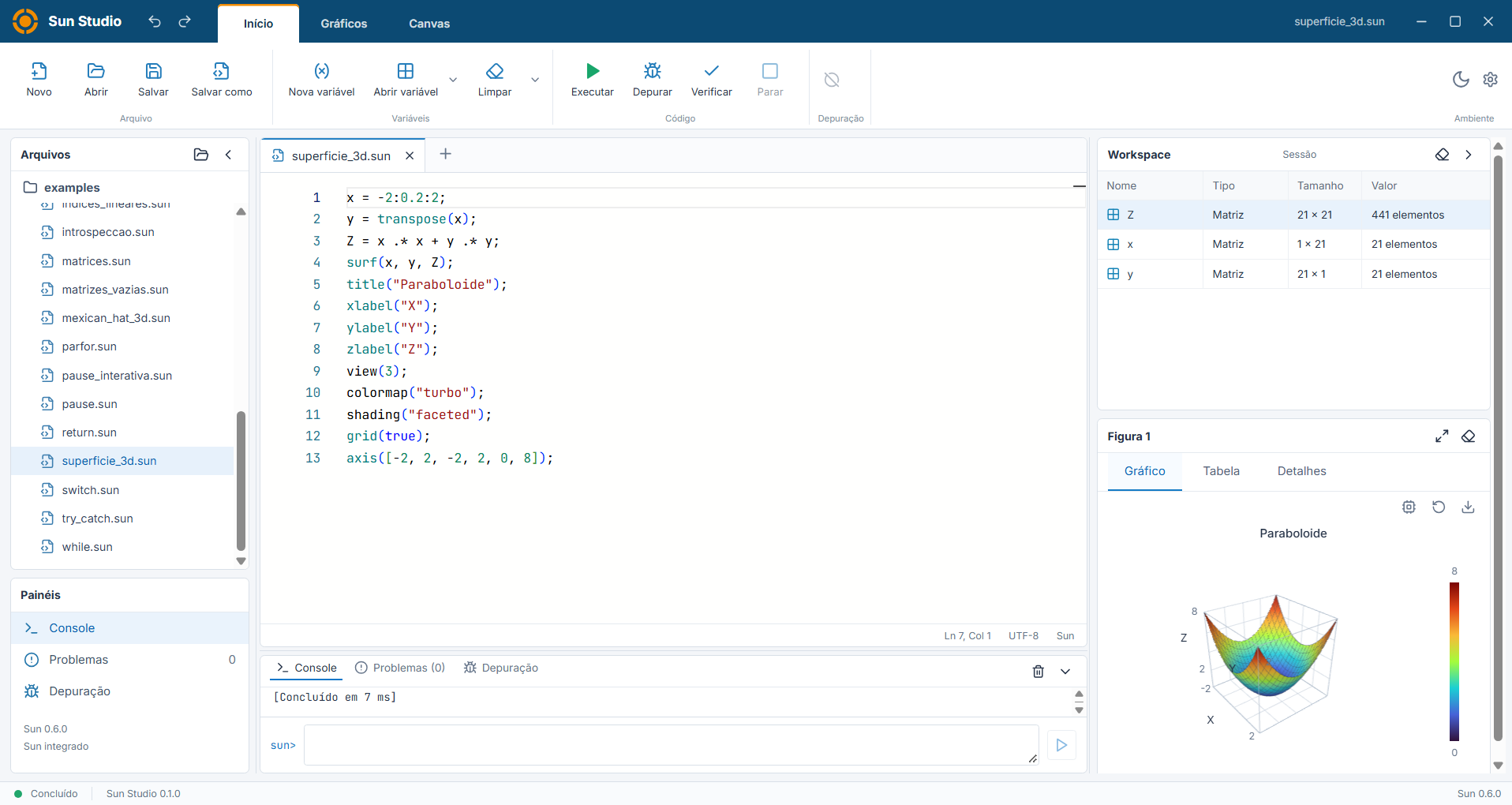
A modern development environment, a new scientific programming language, and an ambitious vision: making scientific computing more intuitive, accessible, and ready for the future. Scientific computing plays a fundamental role in technological innovation. From engineering and artificial intelligence to data analysis and physical simulations, the ability to transform mathematical models into computational results is essential to scientific and technological progress. Yet many of the tools used in this field were originally designed decades ago, in a technological landscape very different from today's. What if we could rethink the scientific computing experience from the ground up? That is the vision behind Sun Studio, a modern development environment built for Sun, a programming language designed for scientific computing, mathematics, and numerical analysis. More than a code editor, Sun Studio aims to provide a workspace where ideas, algorithms, data, and visualizations come together naturally. Sun: A Language Designed for Mathematical Thinking At the heart of the experience is Sun. Built in Rust, Sun is designed to offer intuitive syntax focused on matrix operations, numerical calculations, and scientific algorithms. Rather than requiring complex structures to express common mathematical operations, Sun allows developers to work directly with matrices, vectors, and mathematical functions. Consider a simple matrix multiplication: A = [1, 2; 3, 4]; B = [5, 6; 7, 8]; C = A * B; disp(C); With just a few lines of code, developers can define matrices, perform calculations, and inspect the results. This simplicity is more than a matter of convenience. It allows students, researchers, engineers, and developers to focus on the problems they want to solve rather than the complexity of their tools. Sun's architecture includes an interpreter for interactive execution and an LLVM-based backend, currently under development, for native compilation of a subset of the language. The long-term goal is to combine the expressiveness of a high-level scientific language with a modern technological foundation designed for future optimization. Sun Studio: More Than a Code Editor A scientific programming language deserves an environment that supports the way its users think and work. That is where Sun Studio comes in. Built as a desktop application, Sun Studio brings together the tools needed to write, execute, debug, and explore Sun programs within a single integrated interface. Its code editor provides features familiar to modern developers, including syntax highlighting, multiple tabs, and file navigation. But the real value lies in the connection between code and results. When running a program, users can inspect console output, explore variables, and visualize graphs without leaving their development environment. The result is a continuous workflow where coding, experimentation, and analysis become parts of the same experience. A Workspace That Keeps Your Data in Sight In scientific computing, variables represent much more than values stored in memory. They may contain experimental measurements, transformation matrices, simulation parameters, or the results of complex calculations. Sun Studio includes a Workspace that allows users to inspect variables within an execution session, including their names, types, dimensions, and value information. This makes it easier to understand the state of a program and explore numerical data throughout development. Instead of relying exclusively on printed output, users can observe how their data is organized directly within the interface. Scientific Visualization in Two and Three Dimensions One of Sun Studio's most compelling capabilities is its ability to transform mathematical results into visual representations. Sun already provides functions for creating two-dimensional plots, three-dimensional curves, and 3D surfaces. This makes it possible to explore everything from simple mathematical functions to numerical models of spatial distributions. One example is the famous Mexican Hat, a mathematical surface characterized by a central peak surrounded by concentric waves. x = -12:0.3:12; y = transpose(x); R = sqrt(x .* x + y .* y); R(R == 0) = 0.000001; Z = sin(R) ./ R; surf(x, y, Z); title("Mexican Hat"); xlabel("X"); ylabel("Y"); zlabel("Amplitude"); colormap("turbo"); shading("smooth"); view(3); grid(true); With just a few lines of code, Sun calculates thousands of numerical points, while Sun Studio presents the resulting surface in three dimensions. The ability to visually explore these results makes mathematical models easier to understand and creates valuable opportunities for education, research, and experimentation. From Mathematics to Real-World Problems Scientific computing is often associated with universities and research laboratories, but its applications extend far beyond academia. Matrix operations, statistics, and numerical simulations play an important role across many industries. In manufacturing, they can help analyze sensor measurements, compare production scenarios, and calculate operational indicators. In engineering, systems of linear equations can represent simplified models of electrical circuits, structures, and physical processes. In financial analysis, matrices can be used to evaluate different combinations of costs, revenue, and production volumes. Sun already provides the foundations for developing examples in these areas, including linear algebra operations, statistical functions, control structures, numerical CSV file processing, and parallel execution for certain independent calculations. These capabilities establish a foundation for increasingly sophisticated mathematical and computational applications. Modern Architecture, Distinct Identity Sun Studio is built using technologies widely adopted in modern software development. Its desktop interface uses Electron and web technologies, while the Sun language engine is implemented in Rust. This architecture allows the visual environment and the language runtime to evolve independently while maintaining structured communication between components. Sun Studio also includes debugging capabilities, allowing developers to inspect program execution, work with breakpoints, and examine application state. Rather than simply reproducing the behavior of traditional scientific development tools, the goal is to create a platform with its own identity. One designed to evolve alongside the changing needs of scientific and technical computing. A Platform in Evolution Sun and Sun Studio are still under active development. Some capabilities are already functional, while others remain part of the project's ongoing development roadmap. Sun provides a growing collection of mathematical and numerical operations, but it does not yet offer the extensive scientific libraries and specialized tools available in established computing platforms. Likewise, Sun Studio already integrates code editing, execution, debugging, workspace inspection, and scientific visualization, with further improvements planned in productivity, data exploration, and advanced development tools. This distinction matters. The goal is not to present future capabilities as finished products, but to build a reliable and consistent platform through continuous development. Each new feature is another step toward a more complete scientific computing experience. The Future of Scientific Computing Begins with New Ideas Scientific progress depends on our ability to ask questions, test hypotheses, explore models, and understand complex phenomena. Creating a new scientific programming language is a challenge that brings together mathematics, software engineering, computational performance, and user experience. But it also creates an opportunity to question established conventions and explore new approaches. Sun was born from that perspective: to provide an expressive language for mathematical and computational problems. Sun Studio brings that vision to life by creating an environment where code is not the final destination, but the starting point for experimentation, analysis, and discovery. Together, they represent the foundation of an independent scientific computing platform built to evolve. Sun is the language. Sun Studio is the laboratory. Scientific Computing, Reimagined. About Sun Studio Sun Studio is a desktop development environment for the Sun programming language, featuring integrated tools for code editing, execution, debugging, variable exploration, and scientific visualization. Developed by Sunny Labs, Sun Studio is an evolving platform designed to bring a modern perspective to scientific programming and numerical computing.